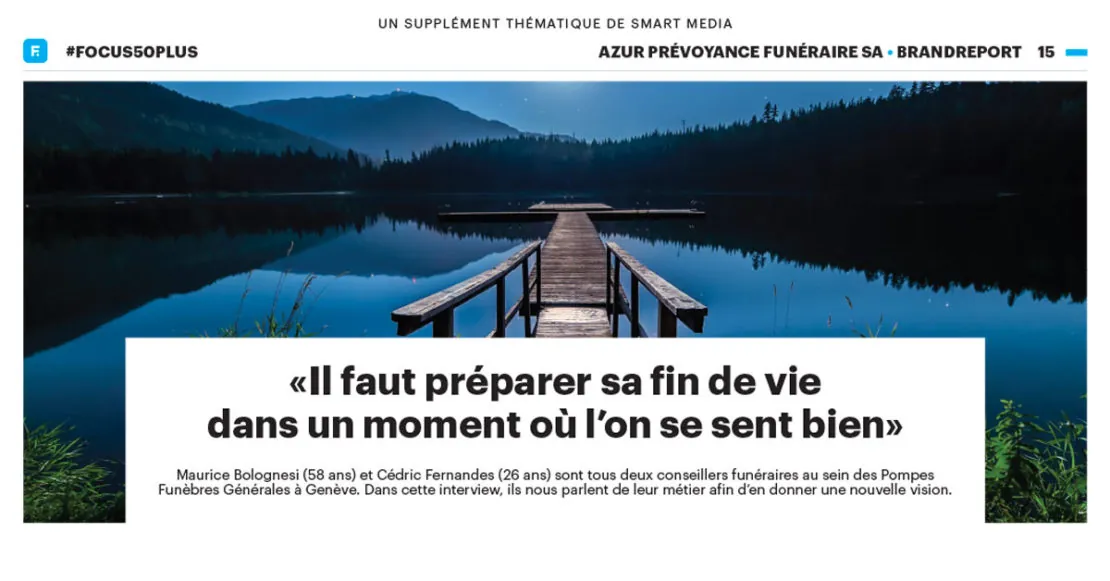
Maurice Bolognesi (58) and Cédric Fernandes (26) are both funeral advisers at Pompes Funèbres Générales in Geneva. In this interview, they talk about their profession and offer a fresh perspective on it.
Maurice Bolognesi
Maurice Bolognesi, why did you choose this profession?
It was an opportunity. I joined the company as an assistant, and my job was to handle the collection of the deceased and ceremonies. Watching the funeral advisers, I realised this was a job I might enjoy.
Is there specific training for your job?
There are several training courses, but I have not taken any of them. Our profession is rich in experience, and I believe the skills are acquired over the years and on the ground.
What do you enjoy most about your job?
The contact with people! I like being close to people. We are also lucky to have a huge network. Through parishes, town halls, the police and embassies, we meet very interesting and completely different people! Away from the office, we sometimes work in incredible places, such as ceremonies at St Pierre Cathedral in Geneva.
How do you manage to cope with the families’ sadness?
You build yourself a shell. My role is to support the families; I cannot show my own sadness.
Some situations are certainly hard to handle, but that is not an obstacle for me. You have to put your heart into it, but also set limits on your empathy.
At work, how do you brighten up your day?
Thanks to my colleagues. There are many moments of sharing in the company. That is very important.
When and how can you prepare for the end of your life with peace of mind?
You should prepare for the end of your life at a time when you feel well. There is no age at which to start thinking about it. You do it first for yourself, but also for your loved ones. Sometimes people want to set up their own plan while they are arranging the funeral of someone close to them, but that is not the right moment. They often also want their funeral to resemble that of the person they have lost, whereas it should reflect who they are. That is why our contracts are personalised.
What would you say to people who feel apprehensive about planning for the end of their life?
By thinking of yourself, you are also thinking of others, because the idea is to ease the burden on those left behind.
Over the years, have you noticed people speaking more freely about funeral services and death?
Yes! I have worked in this field for 18 years and, a few years ago, when I mentioned my job in company, people would change the subject! Today, when I talk about it, everyone is intrigued and asks questions. It is interesting to see how things have changed. I also like talking about my job because I truly love what I do, and I do not find it sad.
Cédric Fernandes
Cédric Fernandes, why did you choose this work?
Becoming a funeral adviser felt like the obvious path for me. When I was younger, I knew people in this field, so it was always familiar to me. A few personal experiences, including the death of my grandmother, brought me to the funeral home several times when I was young.
What qualities does the job require?
“An undertaker is like a swan. It glides elegantly on the surface, but underwater it is paddling furiously!” This line comes from the series Post-Mortem, and I think it sums up our work well. Our job requires an incredible sense of organisation. A wedding planner will take about a year or more to organise a wedding… We only have a few days! And we have to do it while remaining elegant and empathetic, and keeping some distance from the situation. It is an enormous emotional responsibility.
What do you enjoy most about your job?
For me, it is a vocation. Authenticity is very important. When you are facing a grieving family, you are not in a TV film, you are in real life. This job is also essential to society. When I go home in the evening, I know I have been of use to someone.
What values lie at the heart of your company?
Respect is the most important value! Pompes Funèbres Générales Genève is a family business with ethical values. We are not asked to hit profit targets or to manage turnover perfectly. The idea is to adapt to people’s needs. We are not coffin salesmen; we are funeral advisers.
Why prepare for the end of your life?
When we come into the world, we do not know whether we will become rich or poor, be healthy, or have a happy or unhappy life… But death is a certainty, which is why it is better to talk about it. Preparing for the end of your life, or at least talking about it with those around you and breaking the taboos that surround it, is important.
Sometimes families feel lost at the idea of making choices on behalf of the person who has died. We notice that when people have planned things in advance, the meeting is much calmer. In 2002 we founded Azur Prévoyance Funéraire and, as demand keeps growing, it seems natural to me to be involved in it.
In your view, how can families best be supported in their grief?
Listening to their needs and expectations is the key. You also have to work within their budget and sometimes find new solutions. In Switzerland, we are fortunate to have social services that can help families. It is up to us to find simple solutions. We are the appointed funeral provider for the social services in 18 municipalities.