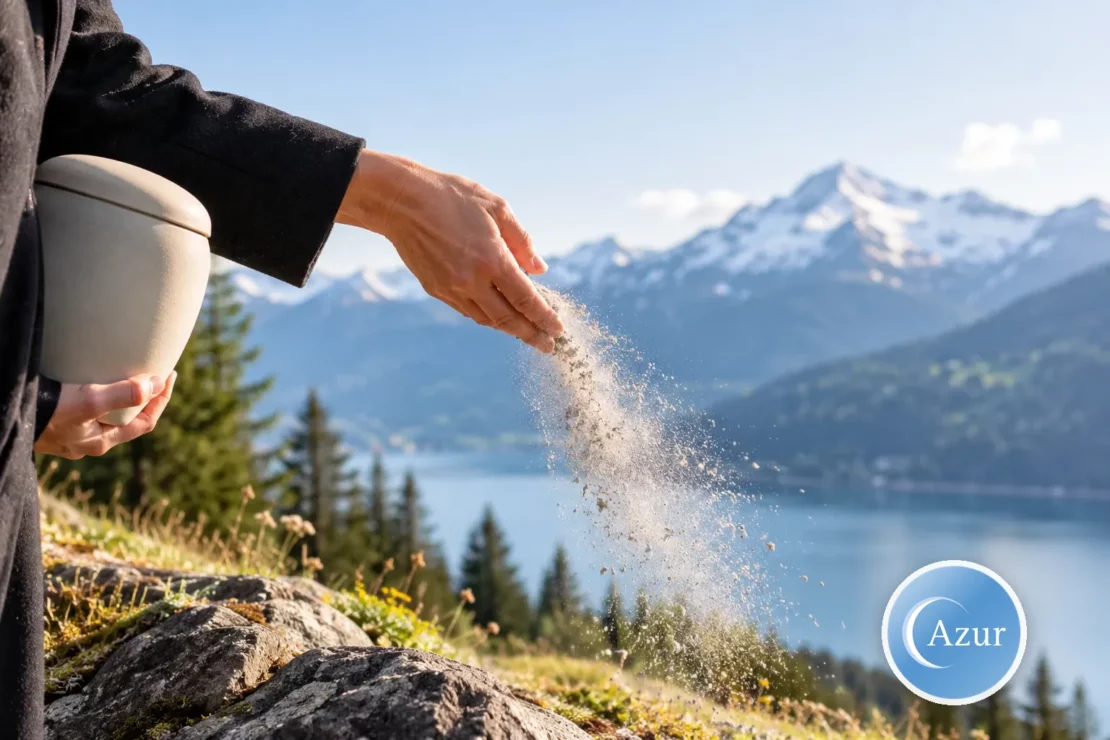
Mostly yes, and that surprises people. Switzerland has no federal law dictating what a family must do with cremation ashes once the urn is handed over. The rules sit with cantons and municipalities, and in practice they are relaxed.
Where the law stands
Swiss practice leans on common sense rather than a thick rulebook. Ashes usually go to relatives, who can keep, bury or scatter them. Germany works the opposite way. Its old Friedhofszwang requires urns to be buried in a cemetery, so some German families send their loved ones’ ashes across the border.
The freedom has edges, though. In canton Zurich, the Supreme Court upheld a ban on Dignitas scattering clients’ ashes outside cemeteries, pointing to public order and security. A family releasing a few handfuls is one thing. An organisation doing it again and again is another.
Places people actually choose
Meadows, forest clearings, a quiet river bank, a lake, a glacier. The mountains come up most often.
Private land needs the owner’s consent, full stop. Public land is a grey zone that is usually tolerated when you stay discreet – a small group, no ceremony blocking a trail, nothing left behind. Lucerne even named an official spot on the River Reuss for Hindu rites, though the exact location is kept quiet.
Trouble starts around protected areas, drinking-water sources and busy bathing beaches. A call to the local commune takes five minutes and can save an awkward chat with a ranger.
| Place | Typical approach |
|---|---|
| Private garden or field | Owner’s consent needed |
| Forest or meadow | Usually tolerated if discreet |
| Lake or river | Generally accepted, avoid bathing spots |
| Alpine slope or glacier | Possible, mind protected zones |
| Cemetery community grave | Always allowed, no guesswork |
Forest burial and other options
Switzerland more or less invented the forest cemetery. In 1993 Ueli Sauter, a Thurgau resident, began burying ashes at the roots of trees, creating what he called a living gravestone. Families typically rent the tree for a fixed term.
If scattering feels too final, there are softer routes:
- A community grave in a cemetery, with no upkeep for the family
- A forest cemetery site beneath a chosen tree
- A biodegradable urn placed in soil or water where permitted
- A memorial keepsake such as jewellery or a diamond made from a small portion of ashes
- A split farewell, keeping a little at home and scattering the rest
Bringing ashes from abroad
Paperwork comes before the view. The funeral home, the airline and sometimes customs will ask for a cremation certificate and a death certificate. If you are travelling from another country, notify undertakers on both sides before you set off.
Putting it in writing
A wish that lives only in someone’s head tends to get lost. Families end up guessing, and guessing is exhausting when grief is already heavy.
Writing it down helps. Providers such as Azur Prévoyance explain how funeral planning works, and their guide to personalising your final farewell shows how to record where you want to rest.
A handful of mountain air
So, can you scatter ashes in Switzerland? Usually, yes, as long as you respect private owners, protected nature and other people’s peace. Ask the commune, pick a quiet spot and leave nothing behind but the moment.